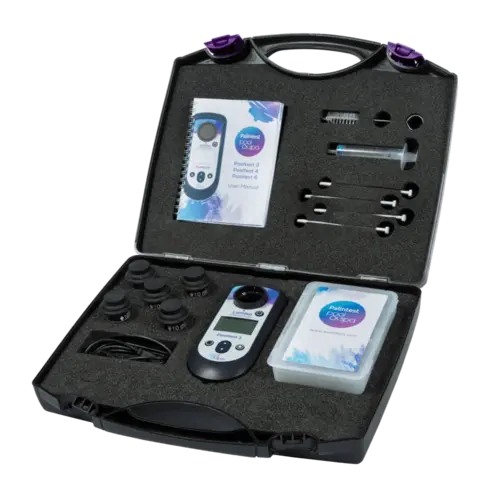
A hands-on half-day course for pool operators, duty managers, lifeguards and plant room staff who test public pool and spa water with a Palintest Lumiso Pooltest photometer (Pooltest 3, 4 or 6).

You will learn how to set up and blank the instrument, take accurate readings for free, total and combined chlorine, pH, total alkalinity, cyanuric acid, calcium hardness and bromine, dilute over-range samples, fix common information messages, verify the instrument with check standards, and use the results log, QR code and sample labels.

You will also learn what your results mean: the minimum and maximum levels set by the NSW Public Health Regulation 2022 for public swimming pools and spa pools, how often testing must be done, what to record, and when to escalate.

This is a THRIV3 non-accredited course. It does not lead to a nationally recognised unit or qualification.

Units Delivered

The following units will be included in your certificate:

P01106 - Lumiso Water Testing

Course Delivery

This course can be delivered/assessed in the workplace or at facility organised by the training provider.

Course Durations

Course durations can vary for multiple reasons, so the durations below are the minimum possible amount.

Face-to-Face face-to-face contact time of at least 4 Hours

There are no formal entry requirements. Participants need to be able to read test instructions and a digital display, handle small tablets and test tubes, and stand for periods in a pool plant room or pool concourse.

Please wear closed-toe, non-slip shoes. Gloves and eye protection are supplied. Let us know before the course if you have a chemical sensitivity or need any adjustment.

This certificate has an industry recommended renewal period of 12 months

Participants are observed by the Trainer while they complete practical water tests, and must successfully demonstrate the following:

  • preparing the instrument and blanking correctly with the water being tested
  • testing free and total chlorine and calculating combined chlorine
  • testing pH and the other parameters available on their facility's model
  • diluting an over-range sample and correcting the result
  • verifying the instrument using check standards
  • recording results and comparing them with the NSW Schedule 1 requirements, including stating the correct action when a result is out of range.

Participants also answer short oral questions. Participants who complete all tasks are marked competent and receive a certificate.

This course does not lead to a nationally recognised certificate